Disclosure: Japan Brief may later earn a commission if you book certain tours or travel services through links on this site. This article does not contain booking links yet, and it is not a sponsored review.
The Japan Meteorological Agency treats winter as December, January, and February. For a traveler in the 2026–27 season, that means 1 December 2026 to 28 February 2027, with a shoulder of cold and snow in November and March in the north. The useful question is not “Does it snow in Japan in winter?” It is “Where is the snow, and when does it stay on the ground?”
This guide uses official climate normals — 30-year averages for 1991–2020 — and confirmed event dates. It does not offer a day-by-day snow forecast for next February. Seasonal outlooks can lean milder or snowier than average; they are still probabilities. A “below-normal snowfall” winter on the Sea of Japan coast can include a week that closes roads.
The three winters you actually choose between
A first-time visitor can usefully split the country into three winter climates.
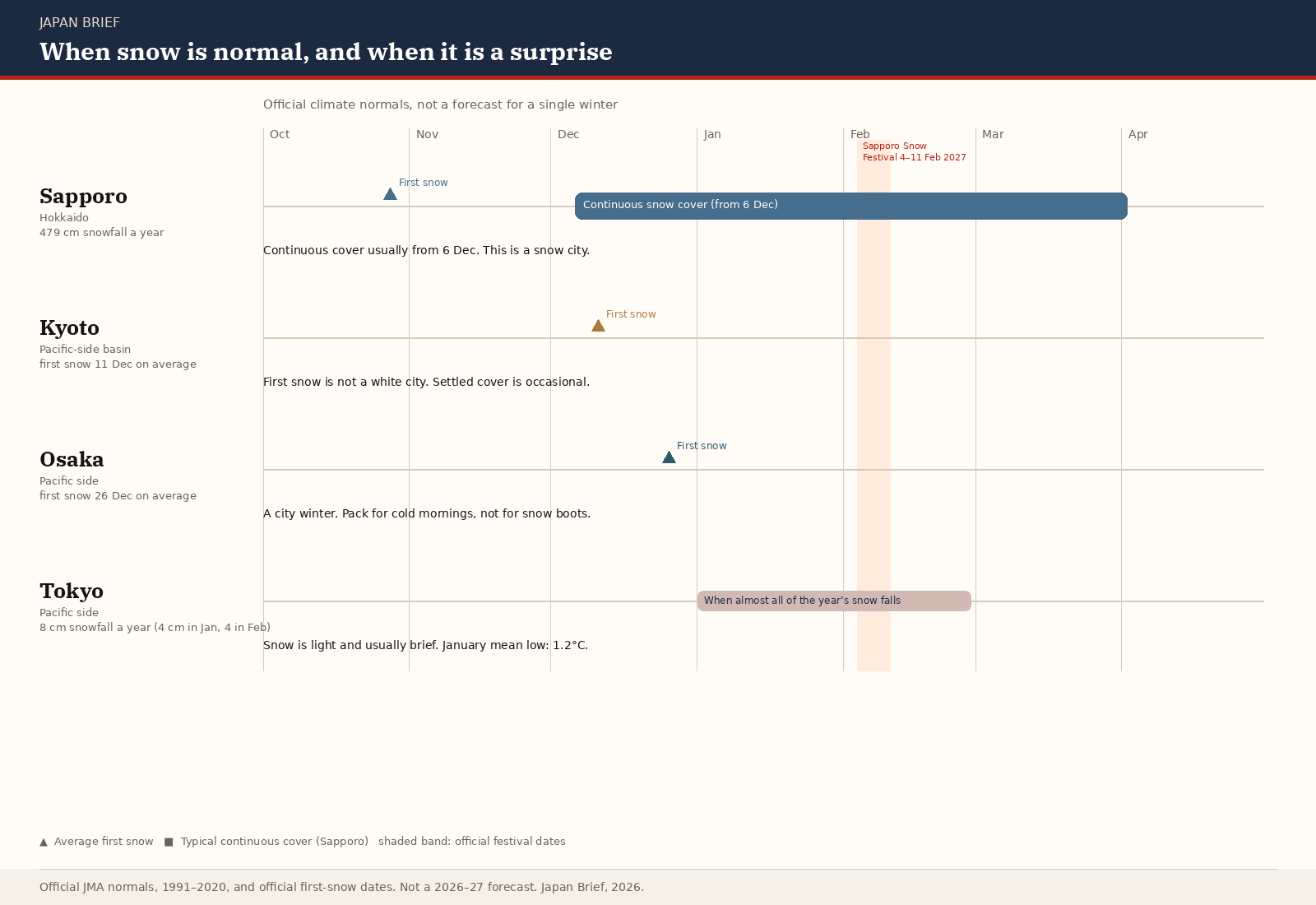
Hokkaido is a snow region, not a snow surprise. In Sapporo, the first snow of the season falls on 28 October on average, and the last on 21 April, according to the official normals published by the JMA’s Sapporo Regional Headquarters. Snow that stays on the ground (at least one centimetre) typically begins around 12 November. A continuous snow cover typically sets in on 6 December and lasts until about 2 April. The city records 479 centimetres of snowfall in a normal year, including 113 centimetres in December, 137 in January, and 116 in February. The average greatest snow depth is 47 centimetres in December, 76 in January, and 95 in February. These are Sapporo figures, not ski-resort figures; mountain towns such as Kutchan, near Niseko, see their average first snow even earlier, on 20 October.
The Sea of Japan side of Honshu — Niigata, Toyama, Kanazawa, and the mountain towns toward Takayama — sits in the path of winter monsoon air that picks up moisture over the sea and drops it as snow. Cities here are cloudy, wet, and genuinely snowy in a way that Osaka is not. If you want snow on traditional streets without flying to Hokkaido, this is usually the belt to aim at, with the usual caveat that “usually” is not a booking guarantee.
The Pacific side, from Tokyo through Nagoya to Osaka and Kyoto, has cooler, drier, often sunnier winters. Tokyo’s mean temperature in January, the coldest month, is 5.4°C, with an average daily high of 9.8°C and a low of 1.2°C. December averages 7.7°C; February, 6.1°C. Osaka is a little milder: 8.7°C in December, 6.2°C in January, 6.6°C in February. These official means hide the feeling on the street. Mornings are cold, interiors are heated, and the air in Tokyo in particular is often dry (the January mean relative humidity is 51 percent).
Snow in these Pacific-side cities is modest. Tokyo’s official snowfall total is 8 centimetres a year, with 4 centimetres in January and 4 in February. Most of it does not stay long. Kyoto’s first snow is 11 December on average, according to the Kyoto Local Meteorological Office; Osaka’s is 26 December, according to the JMA’s Kinki climate page. First snow is not the same as a white city. Kyoto under a settled cover is memorable precisely because it is not the normal morning.
Okinawa is a fourth, optional climate: Naha’s January mean is 17.3°C. It is a way to be in Japan in midwinter without packing for ice. It is not a snow trip, and it is not a substitute for Kyoto.
What the calendar looks like in 2026–27
Late November 2026. By now, Sapporo has usually already seen first snow, and a lasting cover is close. Honshu’s high country and the Sea of Japan coast may have had early snow. Tokyo and Osaka are late autumn turning to early winter: cool, not yet midwinter cold. This is a reasonable moment for a city trip with a warm coat, not for planning a Kyoto snow photograph.
December 2026. In Sapporo, a continuous snow cover usually begins in the first week of the month, and December snowfall is already measured in hundreds of centimetres at the official station. City illuminations in Tokyo, Osaka, and elsewhere run through the month; they are a lighting event, not a snow event. The year-end period, roughly 29 December to 3 January, is one of the busiest travel weeks in the country. Shinkansen seats and many hotels tighten. A large number of restaurants and smaller shops close around New Year. If your 11-day trip crosses that week, book trains early and do not rely on a neighborhood restaurant being open on 1 January.
January 2027. The coldest month in the official means for Tokyo, Osaka, and Sapporo. Tokyo may see snow, but the monthly total averages 4 centimetres. Sapporo is in deep winter: 137 centimetres of snowfall in a normal January, and snow on the ground as a daily fact. For a first-time visitor who wants to be in a snow city, January is a more reliable Hokkaido month than mid-December, and a more reliable month than a bet on Kyoto.
February 2027. Still midwinter. Sapporo’s average maximum snow depth, 95 centimetres, falls in this month. The 77th Sapporo Snow Festival is scheduled for 4–11 February 2027, an eight-day event at the Ōdori, Tsudome, and Susukino sites, with a related snow-sports event at the Daiwa House Premist Dome site on 12–14 February. Those dates were announced by the official festival organizers in July 2026. Hotel rooms in Sapporo, and flights or trains into Hokkaido, should be treated as high-demand around that week. February can also bring the rare, photogenic Kyoto snow — and many mornings with none at all.
March 2027. A shoulder month. Sapporo’s continuous cover typically lasts into early April, so early March can still be a snow trip in Hokkaido. Tokyo and Osaka are moving out of midwinter. Cherry blossom timing is a separate question, and it should not be folded into a snow plan.
Read outlooks as odds, not as a promise
The Japan Meteorological Agency issues a cold-season outlook (寒候期予報) as well as shorter seasonal forecasts. These products say how likely a region is to be colder, near normal, or milder than the 1991–2020 average, and, for some regions, whether snowfall on the Sea of Japan side may be below, near, or above normal. They are issued as probabilities, and they are updated. A mid-September outlook will not tell you whether the week of 8 February is snowy in Kyoto.
For travel planning, use the normals above to choose a region, use the official outlook only as a tilt, and use short-range JMA forecasts in the week before you move. Do not cancel a Hokkaido trip because a seasonal outlook leaned milder: even a warmer-than-average Sapporo winter is still a snow winter. Do not pack only a light coat for Tokyo because “it hardly snows”; 1.2°C at dawn in January is still cold, especially in the wind.
How to travel when there is snow — and when there is not
Trains. The Tokaido Shinkansen between Tokyo, Kyoto, and Osaka is built for winter as a normal season, and it is much less likely to be the problem than a local line in the mountains or a bus on an untreated side road. That said, heavy snow and strong winter pressure patterns do sometimes slow or halt services, including in unexpected places on the Pacific side. Build slack into any day that combines a tight shinkansen reservation with a flight, a ferry to Miyajima, or a remote ryokan pickup. Official company apps and station displays beat social media rumors.
Road travel. If you rent a car in Hokkaido or on the Sea of Japan side in winter, you need a vehicle equipped for snow, and you need to be honest about your own experience on ice. A coastal city such as Osaka in January is a different driving environment from a mountain pass toward Takayama after a night of snow. When in doubt, take the train.
Walking. Waterproof shoes with a genuine tread matter more than a fashion boot. In Sapporo in January and February, you will walk on packed snow and ice between indoor spaces that are very warm. In Tokyo and Kyoto, the more common discomfort is a cold, dry wind and the occasional slick morning after a rare freeze. A compact umbrella is still useful; winter rain happens on the Pacific side too.
Clothing. Layers, a hat, and gloves will take you further than a single enormous coat. Interiors — trains, malls, restaurants — are often well heated. In Hokkaido, add a proper insulated coat and something that blocks wind. In Tokyo in January, a warm coat over a sweater is usually enough, with a spare layer in the bag. The official humidity figures are a hint to pack lip balm and to drink water; they are not a fashion footnote.
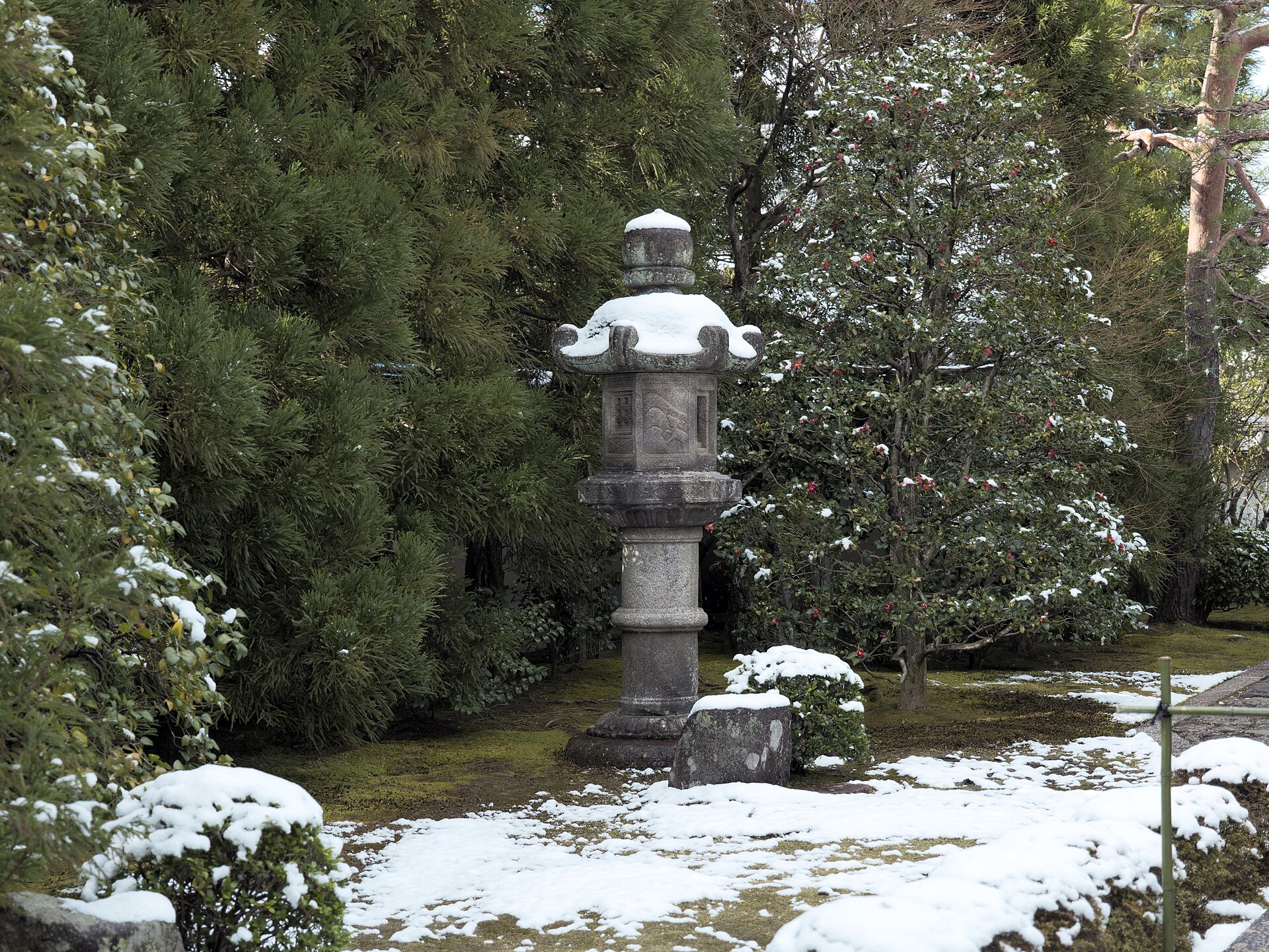
Sightseeing expectations. A snow festival, a ski town, or a Hokkaido city street will give you snow because the climate supports it. A temple garden in Kyoto will give you moss and camellias on most winter mornings, and snow on a few. If a white Kyoto is the only picture you will accept, you are planning a trip around an event you cannot book. Go to Kyoto in winter for quieter paths and clear air, and treat snow as a gift if it happens.
Two honest ways to build the season into a trip
If you want snow to be the point: fly into Shin-Chitose for Sapporo, or combine Sapporo with a resort area only if you have already booked rooms. For 2026–27, the surest public event on the calendar is the Sapporo Snow Festival, 4–11 February 2027. Travel in January or early February if you want depth of snow rather than a specific event. A first-timer can have a complete winter trip without ever going south of Hokkaido.
If Japan’s cities are the point, and winter is just the season you can travel: stay on the Tokyo–Kyoto–Osaka corridor, pack for cold mornings, and do not wait for snow. The 11-day train itinerary in our first-time guide works in winter, with shorter daylight, earlier closings at some outdoor sites, and the New Year caveat above. A side trip to Takayama or Kanazawa can add snow without a domestic flight, if the weather of that week cooperates. Check the week’s forecast, not last year’s photographs.
Group tours that run Tokyo-to-Osaka itineraries in December, January, and February can take some of the logistics out of a first winter visit, including ticket changes if a connection is disrupted. If you look at a tour, read the departure dates around New Year carefully, check whether the trip is a youth departure or a Classic itinerary with no upper age limit, and do not assume that “winter in Japan” on a tour brochure means snow in Kyoto. For a snow-first trip, you want an itinerary that actually spends nights in Hokkaido or on the Sea of Japan side.
A short packing list that is not a catalog
- A coat for 0°C mornings in the cities, and a warmer one if you are going to Hokkaido or the Japan Sea mountains
- Waterproof walking shoes with tread; optional light spike devices only if you are spending a week on ice and know how to walk in them
- Gloves, a hat, and a scarf or neck layer you can take off indoors
- A small umbrella and a day pack, so your coat is not your bag
- Prescription medicines in your cabin luggage, not in a suitcase you might forward
- Screenshots or offline copies of reservations, because cold fingers and station Wi-Fi are a poor combination
Winter is one of the best times to visit Japan if you want fewer crowds in Kyoto and a city that still works when it is cold. It is a poor time only if you arrive expecting the whole country to look like a Snow Festival postcard. Choose the winter you actually want, pack for that climate, and let the official numbers — not the most beautiful photograph — tell you where the snow is.
Sources
- Japan Meteorological Agency, Tables of Climatological Normals (1991–2020), temperatures, precipitation, humidity: https://www.data.jma.go.jp/stats/data/en/normal/normal.html
- Japan Meteorological Agency, Tokyo snowfall normals (1991–2020): https://www.data.jma.go.jp/stats/etrn/view/nml_sfc_ym.php?block_no=47662&prec_no=44&view=a4
- Japan Meteorological Agency, Sapporo snowfall normals (1991–2020): https://www.data.jma.go.jp/stats/etrn/view/nml_sfc_ym.php?block_no=47412&prec_no=14&view=a4
- JMA Sapporo Regional Headquarters, first and last snow normals (Sapporo 28 October–21 April; continuous cover from 6 December; Kutchan first snow 20 October): https://www.data.jma.go.jp/sapporo/tenki/snow-frost-ice/snowfrostice_normals.html
- JMA Kyoto Local Meteorological Office, first-snow normal 11 December: https://www.data.jma.go.jp/kyoto/2_data/kisetsu/index.html
- JMA, climate of the Kinki region, first-snow normals (Kyoto 11 December, Osaka 26 December): https://www.data.jma.go.jp/cpd/j_climate/kinki/main.html
- Official Sapporo Snow Festival, announcement of the 77th festival, 4–11 February 2027: https://www.snowfes.com/news/948.html
- Japan Meteorological Agency seasonal forecasts (check the latest cold-season and three-month outlooks before you travel): https://www.jma.go.jp/jma/indexe.html