Disclosure: Japan Brief may later earn a commission if you book certain tours or travel services through links on this site. This article does not contain booking links yet, and it is not a sponsored review.
The shinkansen is not a puzzle, but it is a system with a few sharp edges. First-time visitors usually get into trouble not because the trains are confusing on the platform, but because they buy the wrong kind of ticket, stand in the wrong car, or board with a suitcase that officially needs a reservation. The ride itself, once you are in a seat, is the easy part.
This guide is about the Tokaido Shinkansen, the line that carries most first trips from Tokyo toward Kyoto and Osaka, and about the rules that continue onto the Sanyo and Kyushu Shinkansen if you keep going west. It is written for independent travelers. Organized tours that use the same corridor exist, and they are a reasonable choice for some people; they are not required.
Nozomi, Hikari, and Kodama are not the same train
On the Tokaido Shinkansen there are three service names. The cars look similar. The difference is how often the train stops, how long the journey takes, and — if you have a Japan Rail Pass — whether you need an extra ticket.
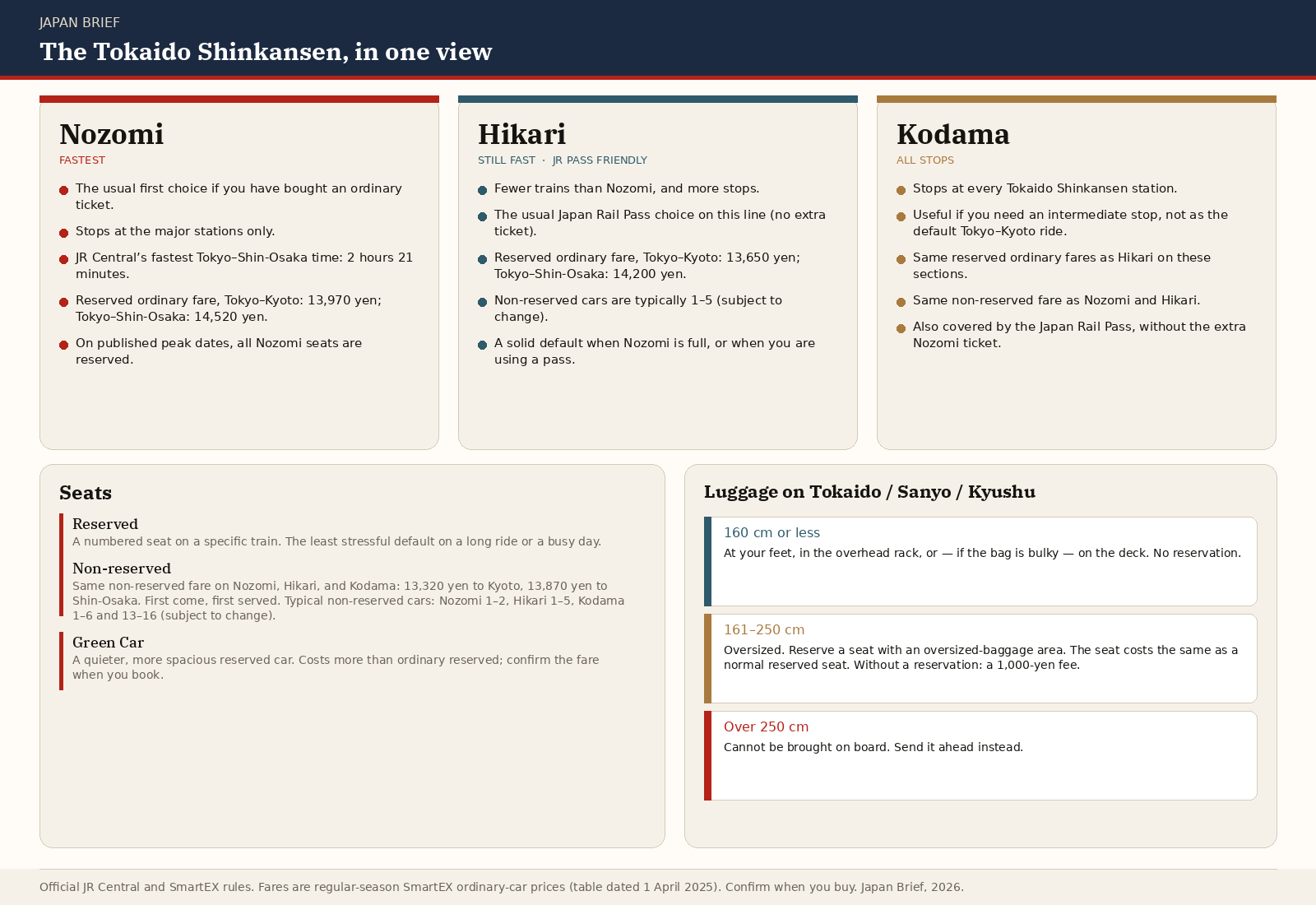
Nozomi is the fastest service and the usual choice if you have bought an ordinary ticket. It stops at the major stations. JR Central’s published fastest time between Tokyo and Shin-Osaka, as of the March 2026 timetable, is 2 hours 21 minutes. If you are going to Kyoto, the ride is a little shorter than that; confirm the exact time on the official timetable for the train you book.
Hikari is still a high-speed train, but it makes more stops and there are fewer of them in the timetable. For holders of a Japan Rail Pass, Hikari is the usual option on this line, because the pass does not by itself cover Nozomi. It is also a perfectly good choice if a convenient Nozomi is full, or if you simply prefer not to pay the small reserved-seat premium that Nozomi carries.
Kodama stops at every Tokaido Shinkansen station. It is the right train if you need one of those intermediate stops. It is not the default for a first-time run from Tokyo to Kyoto or Shin-Osaka, because the extra stops add a lot of time.
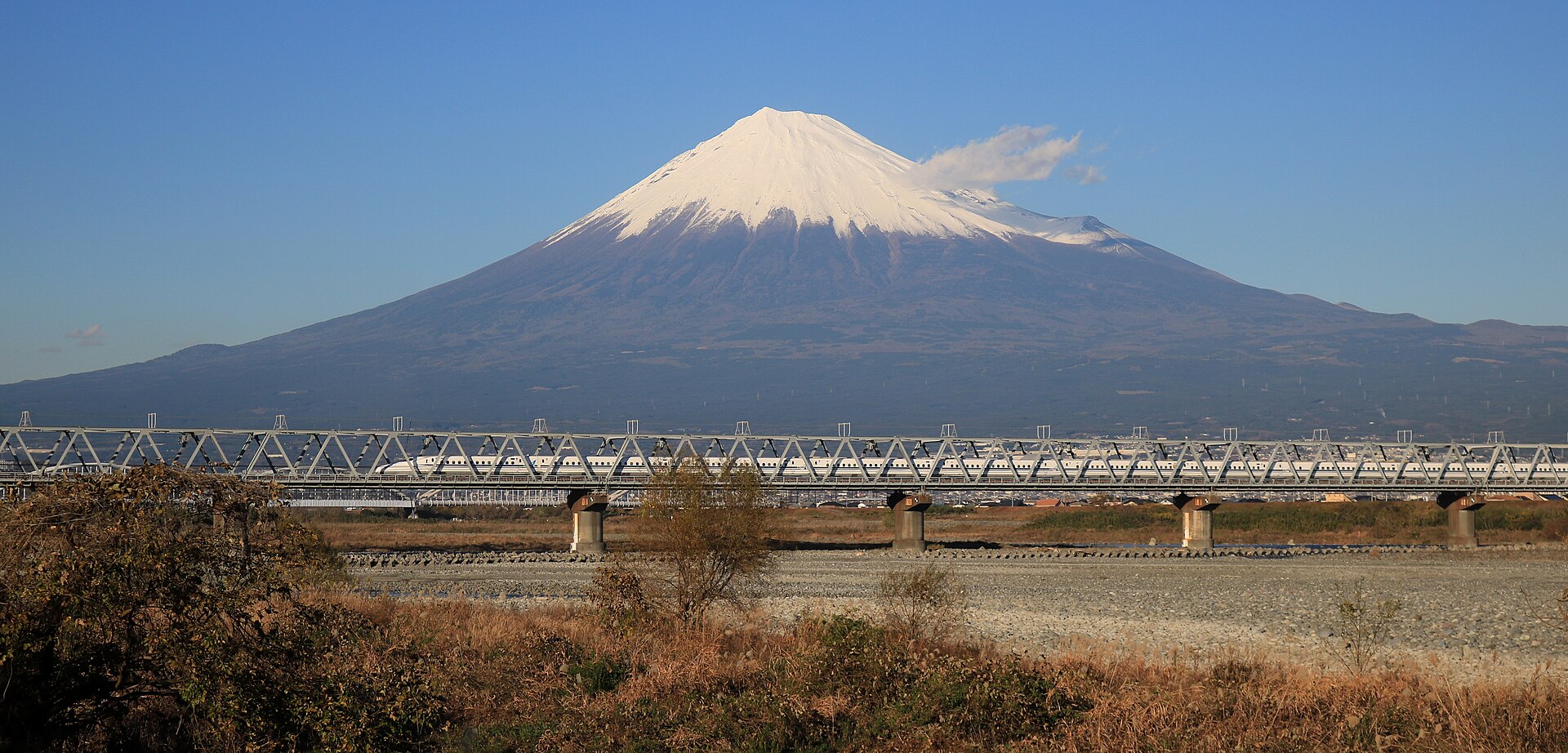
Two details are easy to miss. The Tokaido Shinkansen does not stop at Osaka Station. The shinkansen station for Osaka is Shin-Osaka; from there you change to a conventional JR line for Osaka Station (Umeda) and the rest of the city. And the side of the train with the best chance of a Mount Fuji view does not change with direction. JR Central’s advice is to choose seat E in a standard car, or seat D in a Green Car, and then hope for clear weather. The stretch where the view is most often discussed is between Shin-Yokohama and Odawara, and again between Mishima and Shin-Fuji. The mountain is not guaranteed.
Reserved, non-reserved, and Green
A reserved seat is a numbered seat on a specific train. On a weekday midday ride you may well find a non-reserved seat without drama. On a Friday evening, a Sunday late afternoon, or any of the peak dates listed later in this article, a reserved seat is the difference between a calm two hours and a long stand in a vestibule.
Non-reserved cars are first come, first served. JR Central’s typical layout, which can change, is:
- Nozomi: cars 1–2
- Hikari: cars 1–5
- Kodama: cars 1–6 and 13–16
If you hold a non-reserved ticket, you may board the non-reserved section of any train on your ticketed route that day — including, in ordinary periods, Nozomi. During the published peak periods, though, Nozomi trains have no non-reserved seats at all. With a non-reserved ticket in those periods you may still board a Nozomi, but only standing in the passageway of an ordinary car, not in the Green Cars, and not in a reserved seat. Hikari and Kodama keep non-reserved seats as usual, and those cars can be very full.
The Green Car is a reserved, more spacious car. It costs more than an ordinary reserved seat; confirm the fare when you book. On Nozomi and Hikari services, Green Car passengers can order snacks and drinks to the seat. Ordinary cars do not have onboard food sales, so buy an ekiben (station bento) or a drink before you board. Eating and drinking at your seat is allowed.
There is also a quieter “S Work” car — car 7 on 16-car Nozomi, Hikari, and Kodama trains — intended as a place to use a laptop without a group conversation around you. Travelers may sit there, but chatting and rotating the seats is discouraged.
What it actually costs
A shinkansen ticket is, in the traditional paper system, two things stacked together: a basic fare ticket and a limited express ticket. Online, SmartEX sells them as one combined product. If you travel to or from the shinkansen on a conventional JR train, that local fare is separate.
The figures below are official SmartEX prices for one adult, one way, in the regular season, from the fare table dated 1 April 2025 that was still the table published on the service at the time of writing. Reserved-seat fares move with the official calendar: 200 yen less than the regular-season reserved fare in the off-peak season, 200 yen more in the peak season, and 400 yen more in the super-peak season, for a journey that stays on a single one of the Tokaido, Sanyo, or Kyushu lines. Non-reserved fares do not receive those seasonal adjustments. Confirm the price when you buy.
On SmartEX, the regular-season ordinary-car fares from Tokyo or Shinagawa are:
- Non-reserved, any of the three trains: 13,320 yen to Kyoto, 13,870 yen to Shin-Osaka
- Reserved on Hikari or Kodama: 13,650 yen to Kyoto, 14,200 yen to Shin-Osaka
- Reserved on Nozomi: 13,970 yen to Kyoto, 14,520 yen to Shin-Osaka
Station ticket windows and reserved-seat machines can show different totals from the SmartEX table. Early-bird products also exist on SmartEX, with their own rules and seat limits. None of these numbers is a reason, by itself, to buy a nationwide Japan Rail Pass. As we set out in our 11-day Tokyo-to-Osaka itinerary, a simple out-and-back on this corridor often costs less than the 7-day pass. Add up the JR tickets you would buy anyway, then compare.
How to buy a ticket without a queue
For most visitors on the Tokaido or Sanyo Shinkansen, the official Tokaido Sanyo Kyushu Shinkansen online reservation service — SmartEX — is the least stressful way to buy. You can reserve from 5:30 a.m. Japan time one year before the boarding date, up to four minutes before the train leaves. A booking made more than a month ahead follows a tentative timetable; SmartEX confirms the actual train, time, and seat after 8:00 a.m. one month before departure, and tells you by email. Changes are free until you enter the ticket gate or collect a paper ticket, within the published change rules.
You board with a QR ticket on a phone, or by registering a compatible IC card. The official SmartEX app is offered only in some store regions; if it is not available where you live, use the website. After you scan or tap at the gate, a small seat-information slip may print. It is not the ticket. Do not feed it into the gate when you leave.
The same tickets can be bought at a JR ticket office (Midori-no-madoguchi) or at a reserved-seat machine with an English menu. If you are holding two paper tickets — a basic fare ticket and a limited express ticket — stack them and insert both at once. Take them back when you enter; you will need them to exit.
A Japan Rail Pass is different again. Seat reservations for pass holders go on sale from 10:00 a.m. one month before the departure date. The pass covers Hikari and Kodama on this line. It does not, by itself, cover Nozomi or Mizuho. Pass holders who want those faster trains must buy an “[ONLY WITH JAPAN RAIL PASS] NOZOMI MIZUHO Ticket” before boarding, once for each ride, within the pass’s validity. Official prices include 4,960 yen between Tokyo or Shinagawa and Kyoto or Shin-Osaka, and 6,500 yen to Hiroshima. The same listed price applies to a Green Car ticket, an ordinary reserved seat, or a non-reserved seat, though ordinary-pass holders cannot buy the Green version. The ticket is sold in Japan from one month before travel through the day of travel, at ticket offices, reserved-seat machines, travel centers, and some agencies — not from overseas before you arrive.
The luggage rule that catches people
This is the rule that causes the most expensive surprise at the gate.
On the Tokaido, Sanyo, and Kyushu Shinkansen, a bag whose three sides add up to 160 centimeters or less can travel with you: at your feet, in the overhead rack, or, if it is bulky, in the baggage area on the deck. No reservation is required.
A bag whose three sides add up to between 161 and 250 centimeters is oversized. You must reserve a seat with an oversized-baggage area at the time you buy the ticket. That seat costs the same as a normal reserved seat in the same class. The space behind the last row of certain cars is for the people who hold those reserved seats, not for anyone who finds a gap. If you board with oversized baggage and no reservation, you will be charged a 1,000-yen fee, including tax.
A bag over 250 centimeters cannot be brought on board at all. Send it ahead.
If you are traveling with a large suitcase, reserve the oversized space when you buy the ticket, or send the suitcase ahead with a luggage-forwarding service (takkyubin) and ride with a day bag. Hotel desks can usually arrange forwarding; do not put your passport, medicines, or tomorrow’s clothes in the bag you are sending. If you miss a reserved train, a normal reserved ticket usually lets you sit in a non-reserved car of a later train the same day, on the same route. An oversized-baggage reservation does not travel with you in that way. You cannot take the oversized bag into a non-reserved car; you have to buy a new reserved seat with an oversized-baggage area for the next train.
At the station, and on the train
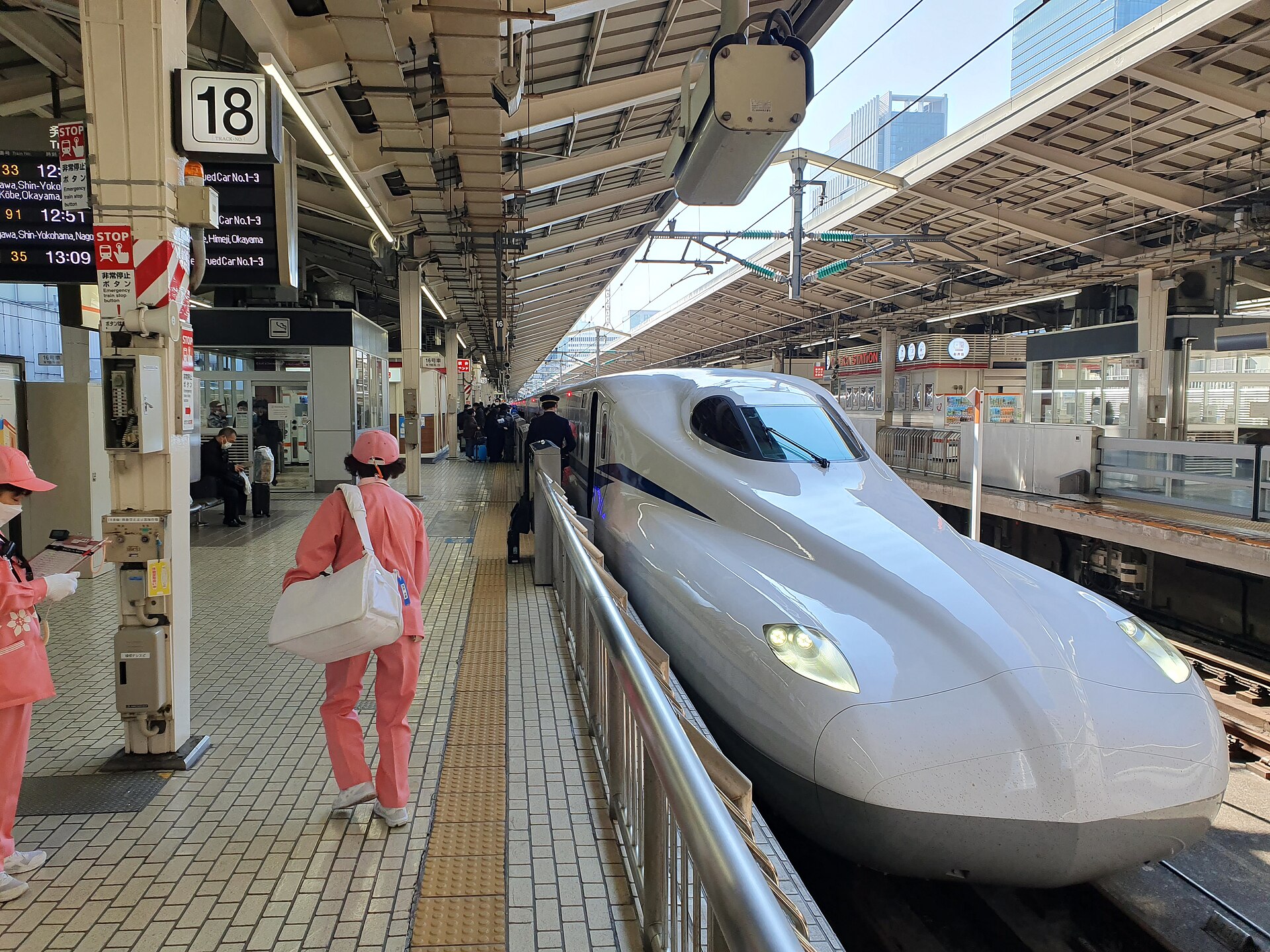
At Tokyo, Shinagawa, Kyoto, and Shin-Osaka the shinkansen platforms are clearly marked, and the departure boards cycle through English. From left to right they typically show the train name, the departure time, the destination, and the platform. Nozomi, Hikari, and Kodama are also color-coded on many boards (yellow, red, and blue are the usual colors). Floor marks show where each car will stop. Stand in the correct lane, let people get off, and board.
If you have reserved a seat, you already know your car and number. If you have a non-reserved ticket, go to the non-reserved cars and take an empty seat. Do not sit in a reserved car with a non-reserved ticket.
On board, free Wi-Fi is available on all Tokaido Shinkansen trains. Power outlets are at every Green Car seat, and on ordinary cars at least at the window seats and the end rows; the newest trains have an outlet at every seat. Voice calls should be taken in the deck between cars. Smoking is not allowed on the train. Restrooms are in the odd-numbered cars, with a larger accessible restroom typically in car 11.
If you miss your reserved train, do not assume the ticket is void. With a SmartEX QR ticket or a conventional paper ticket, you may board the non-reserved section of a later train the same day for the same route — unless you are carrying oversized baggage, as above. If you want another reserved seat, buy one. If a train is delayed or stopped, official displays and the operator’s own service status beat a rumor on your phone. For a delay of more than two hours, SmartEX and the Nozomi Mizuho Ticket both have published refund rules.
The dates when you should not improvise
On certain busy dates, JR Central and JR West operate every Nozomi on the Tokaido and Sanyo Shinkansen as an all-reserved train. The official periods for fiscal 2026, announced jointly by the two companies, are:
- Golden Week: 24 April 2026 to 6 May 2026
- Obon: 7 August 2026 to 16 August 2026
- Silver Week: 18 September 2026 to 23 September 2026
- Sports Day weekend: 10 October 2026 to 12 October 2026
- Labor Thanksgiving weekend: 21 November 2026 to 23 November 2026
- Year-end and New Year: 25 December 2026 to 5 January 2027
- Coming of Age Day weekend: 9 January 2027 to 11 January 2027
- Vernal Equinox weekend: 20 March 2027 to 22 March 2027
If your trip falls in one of those windows, reserve a seat. A non-reserved ticket will not get you a Nozomi seat, and the remaining non-reserved cars on Hikari and Kodama will be the first place everyone else goes. The same advice applies, more loosely, to ordinary Friday evenings and Sunday late afternoons even outside those dates.
Winter weather can slow or stop services even on this usually reliable line, especially when a forecast is severe on the Pacific side. Build slack if you are connecting to a flight. Our winter 2026–27 guide covers that season in more detail.
A simple way to decide
For a first independent trip along this corridor, the low-stress pattern is:
- Buy a reserved ordinary seat on the specific train you want to catch, through SmartEX or at a reserved-seat machine.
- Choose Nozomi if you have a regular ticket and you want the most frequent, fastest option. Choose Hikari if you are using a Japan Rail Pass, or if a convenient Nozomi is full.
- Measure your suitcase. If the three sides add up to more than 160 centimeters, reserve the oversized space or send the bag ahead.
- Arrive at the station with enough time to find the platform and the car mark, not with enough time to invent a new plan.
- Sit down, eat if you like, and get off at Kyoto or Shin-Osaka. The city starts after the ticket gate, not on the platform.
If you would rather not make these decisions yourself, a guided itinerary that already includes the long train rides is a fair alternative — including Classic-style tours with no upper age limit, not only departures aimed at travelers aged 18–39. The facts above do not change because a tour is involved. The pass maths, the luggage rule, and the peak-date calendar are the same.
You do not need to become a timetable expert. You need a reserved seat on a train that your ticket actually covers, a bag that is allowed in the car you board, and a platform you can find without running.
Sources
- JR Central, “Luggage information” (oversized baggage rules and 1,000-yen fee): https://global.jr-central.co.jp/en/info/oversized-baggage/
- JR Central, “Shinkansen Perfect Guide” (ticket gates, non-reserved car numbers, missed-train rule, Mount Fuji seats, onboard rules, Tokyo–Shin-Osaka 2 hours 21 minutes): https://global.jr-central.co.jp/en/goldenroute/shinkansen/
- JR Central, all-reserved Nozomi peak periods: https://global.jr-central.co.jp/en/nozomi/ and https://railway.jr-central.co.jp/nozomi/
- JR Central and JR West, press release, 21 May 2026, “Period of all-reserved seating on Tokaido and Sanyo Shinkansen Nozomi trains (FY2026)”: https://www.westjr.co.jp/press/article/2026/05/21/items/260521_00_press_nozomi_shiteiseki.pdf
- SmartEX, service rules, reservation window, seasonal reserved-seat adjustments: https://smart-ex.jp/en/product/plan/service/
- SmartEX, reservation reception times: https://smart-ex.jp/en/reservation/useful/accept_time/
- SmartEX, official ordinary reserved-seat fare table, as of 1 April 2025: https://smart-ex.jp/en/product/plan/service/pdf/service_fares_reserved.pdf
- SmartEX, official ordinary non-reserved fare table, as of 1 April 2025: https://smart-ex.jp/en/product/plan/service/pdf/service_fares_non_reserved.pdf
- Japan Rail Pass, “Use of NOZOMI/MIZUHO trains” (special ticket rules and prices): https://japanrailpass.net/en/use/special-ticket/
- JR Central, “Special ticket for NOZOMI with JAPAN RAIL PASS”: https://global.jr-central.co.jp/en/onlinebooking/contents/jrp_nozomi/
- Japan Rail Pass, types and prices: https://japanrailpass.net/en/purchase/price/
- G Adventures, trip listing and FAQs (age rules vary by trip style): https://www.gadventures.com/faqs/