Disclosure: Japan Brief may later earn a commission if you book certain tours or travel services through links on this site. This article does not contain booking links yet, and it is not a sponsored review.
The first night in Tokyo is not a sightseeing problem. It is a logistics problem with a tired person in the middle of it. The arrivals that go well look almost dull from the outside: you get off the plane, you take a train you already understand, you check in, you eat, and you go to bed. The arrivals that go badly usually start with a plan to “see a little of the city” before anyone has a room, a working transit card, or a sense of which station exit is which.
This guide is about that first night only. It is for people landing at Narita or Haneda and staying in the city, often at the start of a longer first trip such as our 11-day Tokyo-to-Osaka itinerary. Independent travel is the default here. A guided first day can make sense if you would rather not navigate the airport trains yourself, including Classic-style tours with no upper age limit. It is not required.
Choose the train that matches the airport, not the one you have heard the most about
Narita and Haneda are not interchangeable, and the right city train is the one that starts at the airport you actually land at.
If you land at Narita, two reserved-seat airport trains do most of the useful work.
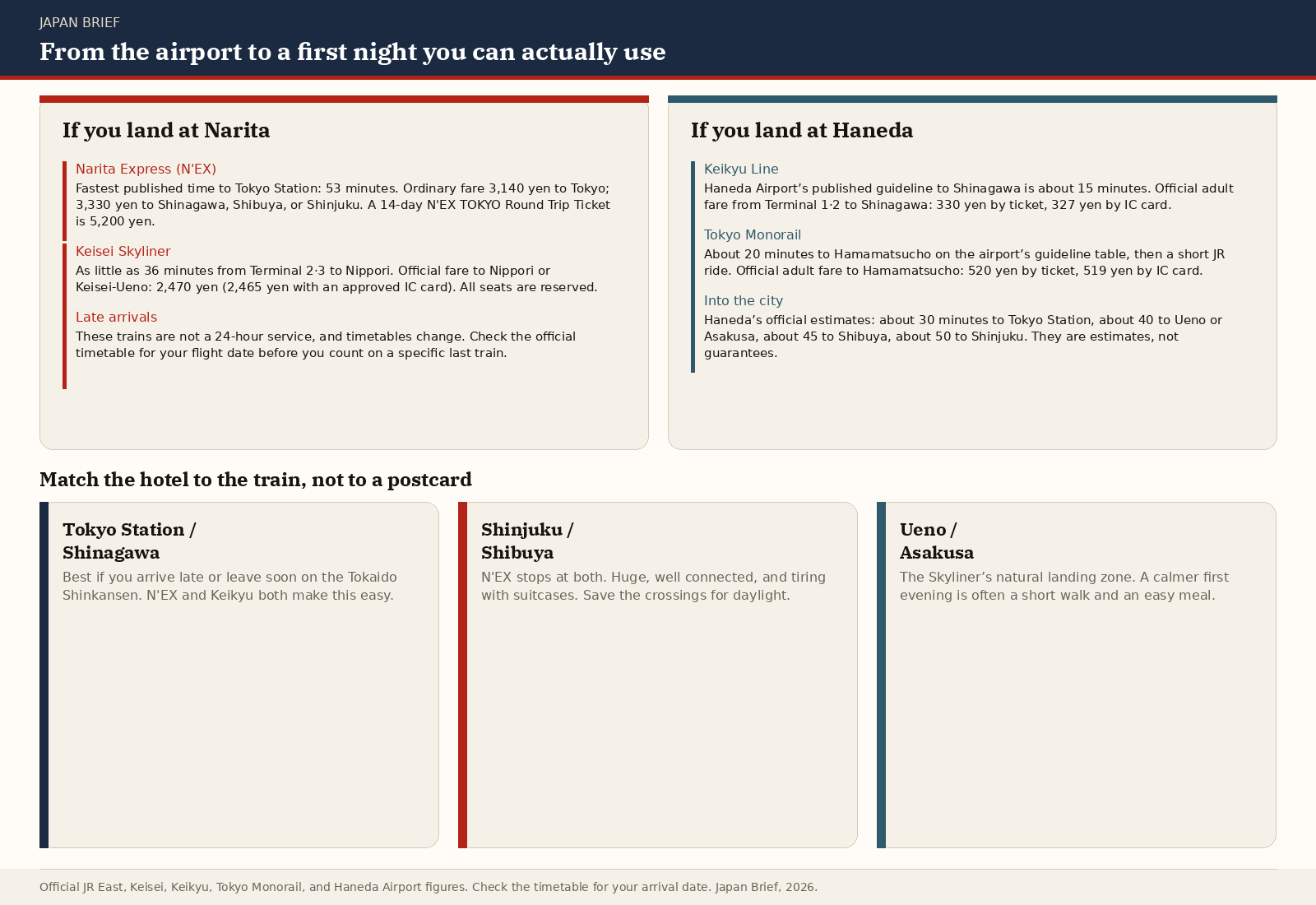
The JR Narita Express, or N’EX, is the direct JR option into the main city stations. JR East’s official fastest time from Narita Airport Station to Tokyo Station is 53 minutes, with no transfer. Official ordinary-car fares, last updated on the company’s English ticket page on 14 March 2026, are 3,140 yen to Tokyo and 3,330 yen to Shinagawa, Shibuya, or Shinjuku. Green Car fares on the same sections are 3,910 yen and 4,100 yen. Those prices are the same all year. The train has luggage space, and JR East says a reservation is not required for that space, though the area is first come, first served and a very large bag may not fit.
If you will also use the N’EX on the way back to Narita within 14 days, look at the official N’EX TOKYO Round Trip Ticket, which is 5,200 yen. It is not an unlimited pass; it covers one arrival and one departure in the published area, and you pick it up at the airport stations. Seat reservations for N’EX can be made online through JR-EAST Train Reservation, or at the airport ticket offices and passport-reader machines. If you miss your reserved train because a flight is late, JR East’s rule is that you may board a later N’EX the same day without an assigned seat, and you must give the seat up if someone with a reservation for it boards.
The Keisei Skyliner is the other main reserved-seat option. Keisei publishes a fastest time of 36 minutes from Narita Airport Terminal 2·3 to Nippori. The official fare from either airport terminal to Nippori or Keisei-Ueno is 2,470 yen, or 2,465 yen if you use an approved IC card at the gate. All Skyliner seats are reserved. From Nippori or Ueno you can continue on JR or subway lines; the official fare tables already show sample totals if you add a short JR ride to Tokyo, Shinagawa, or Shinjuku. Online and advance discount tickets exist; check the current offer on Keisei’s official site rather than assuming a number you saw last year.
There are cheaper, slower Keisei trains as well. They are a reasonable choice if you are not in a hurry and you want to save money, but they are a poorer choice if you have just left a long-haul flight with a suitcase.
If you land at Haneda, you are already much closer to the city, and you usually do not need a reserved-seat express.
Haneda Airport’s own guideline table gives about 15 minutes to Shinagawa and about 20 minutes to Hamamatsucho, then about 30 minutes to Tokyo Station, about 40 minutes to Ueno or Asakusa, about 45 minutes to Shibuya, and about 50 minutes to Shinjuku. Those are estimates, not promises.
The two official rail options are the Keikyu Line and the Tokyo Monorail, both with stations in the terminals. Keikyu is the natural choice if your hotel is near Shinagawa or if you want a fast connection onto the JR network there. The official adult fare from Haneda Airport Terminal 1·2 to Shinagawa is 330 yen by ticket and 327 yen by IC card. The Tokyo Monorail runs to Hamamatsucho, where you change to JR. The official adult fare to Hamamatsucho is 520 yen by ticket and 519 yen by IC card.
Buy a Welcome Suica or use a compatible mobile IC card if you already have one, as described in our 11-day itinerary. It will not cover the reserved N’EX or Skyliner fare by itself, but it will cover the Keikyu or monorail ride, the subway, and a great many convenience-store dinners. Do not activate a nationwide Japan Rail Pass on this first evening unless the pass maths already say you should. For most first trips that start with several days in Tokyo, an IC card is enough until the morning you leave for Kyoto on the shinkansen.
Late flights, and the timetable you should not guess
Airport trains are not a 24-hour service. Last departures change when operators revise their timetables — Keisei, for example, has been publishing timetable changes in late November 2026 — so a last-train time copied from an old blog post is a bad thing to rely on after a delayed flight.
Before you fly, check the official N’EX, Skyliner, Keikyu, and monorail timetables for your arrival date, and have a backup in mind: a later local train if one exists, an official airport bus, or a hotel at or near the airport if you are landing after the last useful city service. If you have reserved an N’EX or Skyliner seat for a specific train, build in time for immigration and baggage. Changing a reservation is much easier before the train has left than after you have missed it.
A taxi from Narita all the way across Tokyo can be arranged, but it is the expensive way to do a journey that the trains are built for. From Haneda the taxi ride is shorter, and still usually costs more than the train. If you do take a taxi, use an official stand, and do not expect the driver to speak the plan you wrote in English at 30,000 feet.
Where to stay: match the hotel to the train
The useful question is not “what is the best neighborhood in Tokyo.” It is “which station can I reach without changing trains at 10 p.m. with a suitcase.” Hotel prices, noise, and room size vary block by block; look at the actual address, and at how many minutes the walk from the nearest station really is.
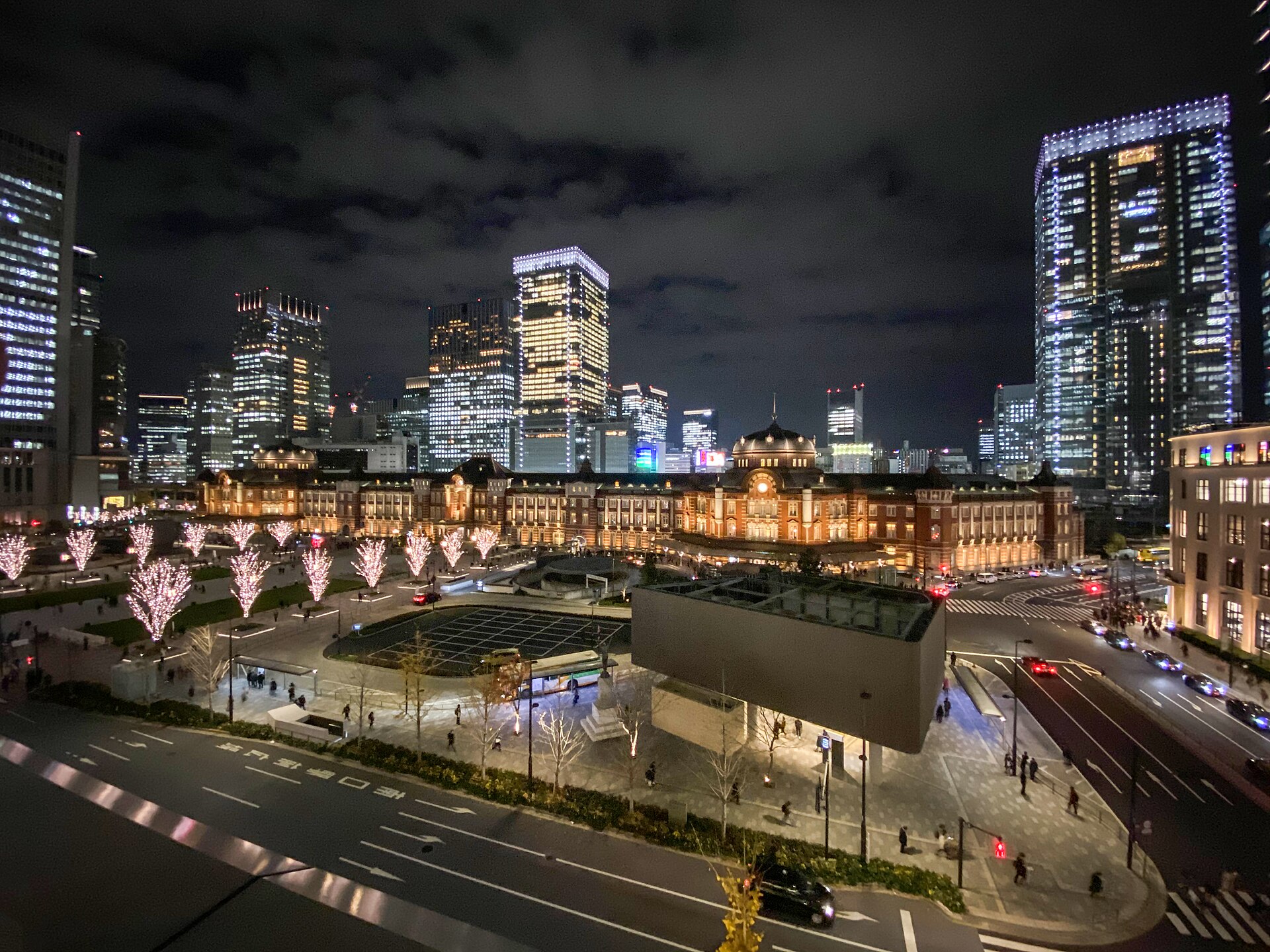
Tokyo Station, Marunouchi, Yaesu, and Shinagawa are the most forgiving places to stay if you arrive late or if you will soon leave on the Tokaido Shinkansen. N’EX runs to Tokyo and Shinagawa. Keikyu from Haneda arrives at Shinagawa. The shinkansen platforms are in the same stations. The area around Tokyo Station is businesslike after dark, which is a virtue on night one: the streets are lit, the convenience stores are open, and you are not wandering a nightlife maze. It can also feel a little impersonal. That is acceptable for a first night.
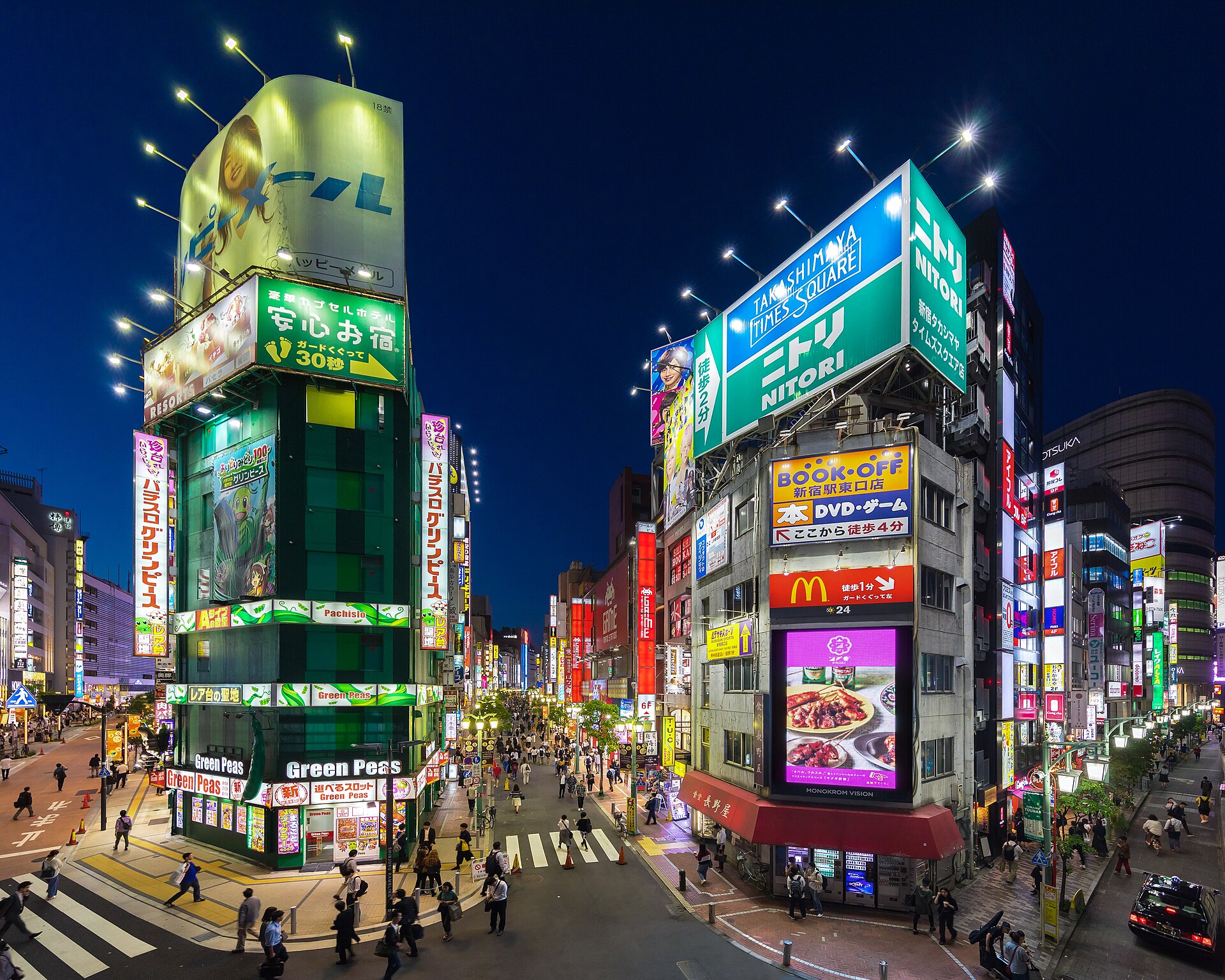
Shinjuku and Shibuya are the neighborhoods many first-time visitors have already seen in photographs. N’EX stops at both, which makes them practical from Narita. They are huge, well connected, and tiring with luggage. Shinjuku in particular is easy to get lost in once you leave the station. If you stay here, choose a hotel whose directions you can follow when you are exhausted, and treat the neon as tomorrow’s walk, not tonight’s assignment. Shibuya Crossing will still be there in daylight.
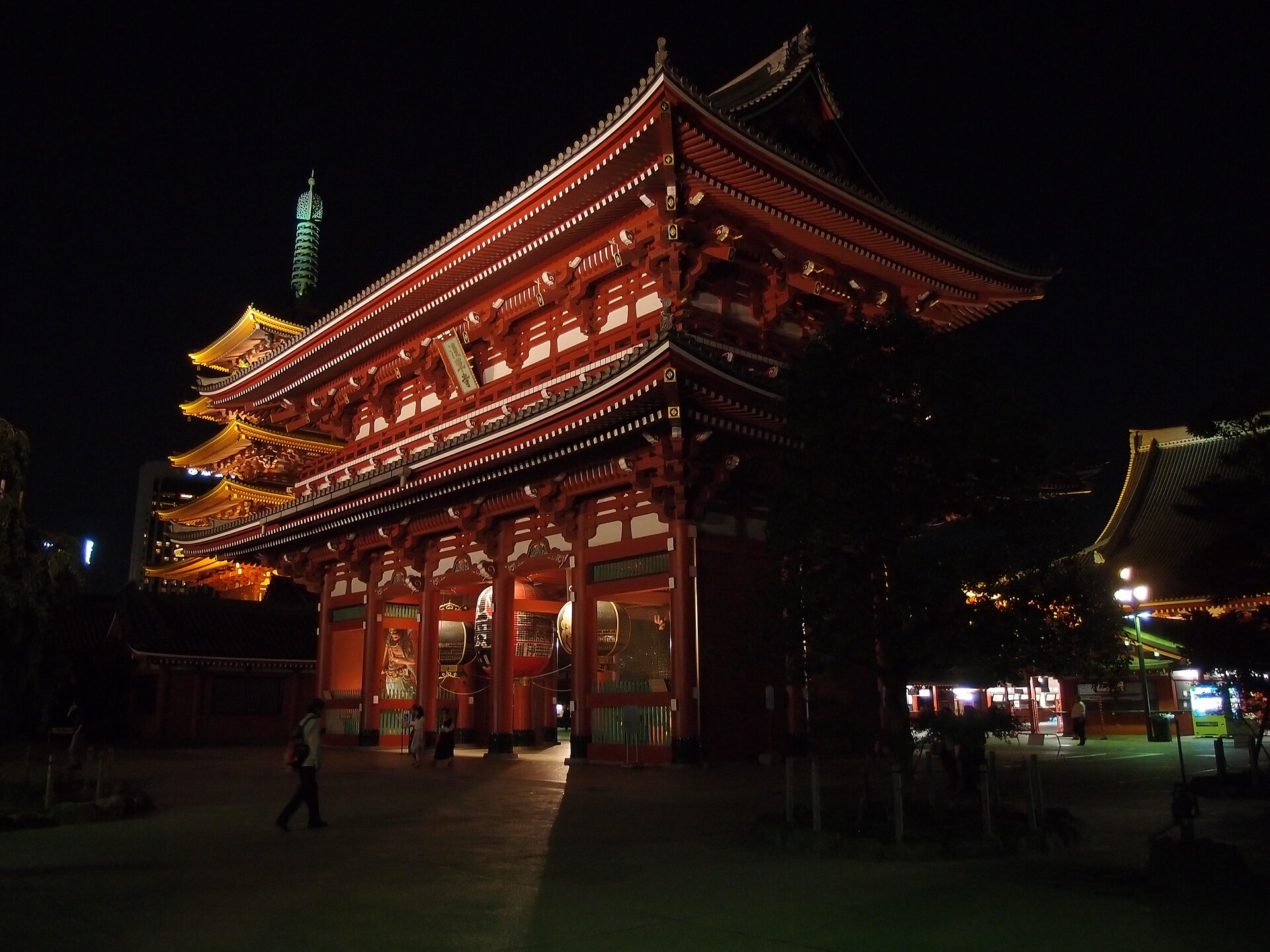
Ueno and Asakusa sit naturally at the end of a Skyliner ride, and they are often a calmer first evening than the western side of the Yamanote Line. Asakusa has a temple approach you can walk slowly if you still have any curiosity left; Ueno has a large station, parks, and a slightly less frantic feel after dark. Both are a longer hop from Shibuya or Shinjuku, which matters on day two, not on night one. If your first full day is on the east side of the city, they are a very good fit.
Other bases — Ikebukuro, Roppongi, Tokyo Bay — can work if you have a reason to be there. They are not clearer first-night answers than the three groups above.
Wherever you stay, confirm the check-in time with the hotel before you fly. Many rooms are not ready until mid-afternoon. If you land in the morning, a locker at the station, a shower in the airport, or an early-luggage drop at the hotel will do more for you than a forced march through a famous crossing with your suitcase.
What to skip on night one
Skip the idea that you should “see Tokyo” before you sleep. In particular:
- Shibuya Crossing, Shinjuku’s nightlife grid, and any viewpoint that requires a timed ticket. They are better when you can stand still and look.
- Theme parks, teamLab-style museums, and anything with a reserved entry that you will resent missing if the airport is slow.
- A long restaurant reservation across town. A convenience-store meal, a chain restaurant near the hotel, or a bowl of noodles on the same block is a successful first dinner.
- Buying and activating a nationwide rail pass “just in case.” Do the arithmetic in daylight.
- A first-night drinking plan that assumes you will still be good company after a long-haul flight.
A short walk around the hotel is not a waste. It tells you where breakfast might come from, and it gives your body a little daylight or evening air after the cabin. If you are in Asakusa and the approach to Sensō-ji is still open and quietly lit, a slow loop can be a lovely first hour. If you are in Shinjuku, the same instinct can lead you into a very loud street before you have a mental map. Be conservative.
Jet lag is ordinary and not something this site can medically advise you on. A practical pattern is: get to the room, eat a simple meal, see a little evening light if you can, and sleep when you can. Do not invent a 6 a.m. market visit as a cure. A wholesale-market trip is a separate, planned morning, not a first-night improvisation.
The first morning, once you have slept
When you wake up, the city is a different problem, and a much nicer one. Get a coffee or tea, confirm that your IC card works, and pick one neighborhood for the morning rather than three. Our 11-day plan suggests a traditional district, a modern crossroads, and a green space across the Tokyo days, not all before lunch on day one. If pop culture is the reason you came, official ticketed places such as the Ghibli Museum still need advance reservations; see our pop-culture guide.
If this is also the morning you will later leave for Kyoto, do not make it the morning you first learn the shinkansen ticket machines. Buy that ticket the day before, or at least the evening before, especially on a Friday or before a holiday weekend.
The point of a first night in Tokyo is to still be glad you came when you open the curtains. A reserved airport train, a hotel you can find, a simple meal, and a crossing you have not yet attempted are a better start than a photograph you will not remember taking.
Sources
- JR East, “N’EX (Narita Express)” (fastest time to Tokyo Station, onboard facilities, luggage): https://www.jreast.co.jp/en/multi/nex/
- JR East, “N’EX (Narita Express) Tickets” (fares as of 14 March 2026, how to buy, missed-train rule): https://www.jreast.co.jp/en/multi/nex/tickets/
- JR East, “N’EX TOKYO Round Trip Ticket”: https://www.jreast.co.jp/en/multi/pass/nex.html
- Keisei Electric Railway, Skyliner fares from major stations: https://www.keisei.co.jp/keisei/tetudou/skyliner/us/traffic/skyliner_fares.php
- Keisei Electric Railway, Skyliner discount and fastest published time to Nippori: https://www.keisei.co.jp/keisei/tetudou/skyliner/us/tickets/coupon.php
- Haneda Airport, official train and monorail access and guideline times: https://www.tokyo-haneda.com/en/access/train/index.html
- Keikyu Corporation, official fare table from Haneda Airport Terminal 1·2: https://www.keikyu.co.jp/ride/ticket/pdf/KK17.pdf
- Tokyo Monorail, official fare table: https://www.tokyo-monorail.co.jp/english/guidance/train_info.html
- JR East, “Welcome Suica”: https://www.jreast.co.jp/en/multi/welcomesuica/welcomesuica.html
- The official Tokyo travel guide, GO TOKYO, first-timer walks: https://www.gotokyo.org/en/story/walks-and-tours/for-the-first-timer/index.html
- G Adventures, FAQs (age rules vary by trip style): https://www.gadventures.com/faqs/